Los Padres
National Forest
Figueroa Mountain Wildflower
Update - First Update of the 2017 Season
March 16, 2017
Greetings
and happy almost spring! Welcome to the 2017 wildflower season! Because of the
much needed rain and the colder weather on Figueroa Mountain, the wildflowers
are getting a late start. This is very common for a wet year. With this said,
while the wildflowers are starting to bloom, there really aren’t that many yet,
but finally enough for a short report. Keep in mind that most of the wildflower
that are currently blooming are in the lower elevation, below 3,000 feet, with
the exception of the south facing slopes, which get the sun shine most of the
day.
A
friendly reminder before we begin. When you stop to look and take pictures of
all the beauties, please make sure that you park on the shoulder of the road
and not on the road itself. If there isn’t a place to stop, find a turn-out and
walk back to the area. Please do not block the road at any time as this will be
enforced.
Ready
to start our tour? Let’s go!
Starting
at the first cattle guard, shiny buttercups, milk maids, blue dicks, delightful
fiesta flowers, fiddlenecks, Johnny jump-ups, fillaree and miners lettuce are
in bloom. In fact, I even spied a lomatium, 2 lupine and golden yarrow hiding
among the tall grass. These same flowers can be spotted all the way through to
the enchanting tree canopy area, only add popcorn flowers to this lovely mix.
As
you continue up the hill, beautiful California poppies are beginning bloom. In
fact, look to your left and see the stunning orange patch work on the top
portion of Grass Mountain. Grass Mountain put on quite a show last year. Let’s
see what it does this year. Right before you get to the rusty gate, look to the
right and find some tiny cream cups in bloom, along with fillaree and a few
poppies.
Other
wildflowers to look for as you continue your uphill climb include, Ceanothus,
buttercups, fiddleneck, fillaree, blue dicks, a few lupine, carpets of
goldfields, stunning orange wall flowers along the rocky hill on the right,
shooting stars, and coreopsis.
At
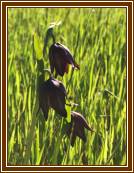
Vista Point (large gravel turnout about 11.4 miles from the bottom), everyone’s
favorite, the exquisite chocolate lilies are in bloom, be careful not to step
on them so that other may enjoy them. Also look for shooting stars, goldfields
and fillaree. I even spotted a couple of wild onions. In the serpentine area across Vista Point and along the road
leading to the station, you’ll see California poppies, buttercups, blue dicks,
coreopsis, golden yarrow and wild onions.
As
you pass the station, fields of gorgeous shooting stars can be seen, ranging in
color from deep magenta to purple to the occasional white blooms. Buttercups
can also be spotted here.
In
the field to the right, before Tunnell Ranch Road, look for poppies and
buttercups.
About
a half mile further, the infamous poppy hillside is about one quarter filled.
This year the poppies in this area appear smaller, but still beautiful. It also
seems as though they will be sharing the spotlight with lovely lupine this
year.
As
we continue on Figueroa Mountain Road to the Davy Brown trailhead, there is
little to see. Look for a few poppies, Ceanothus and a couple of purple
nightshades, which can be seen on the hillside, right before the trailhead.
About
one half mile further, you will find some colorful fields, housing beautiful
shooting stars, lomatium and buttercups.
From
this point, there is very little to report. From Ranger Peak to Cachuma Saddle,
because of the higher elevation, the flowers are just starting to bloom. One
might see an occasional bush poppy, few California poppies, a couple of bush
lupine, some wild canyon peas can be spotted in a few locations and some purple
nightshade towards the Cachuma Saddle side. While just starting, the bush
lupine should be putting on quite a display in about 3 weeks or so. Stay tuned!
Sunset
Valley has even less to report for right now.
At
this point, because of the damage incurred to the dirt section of Happy Canyon
Road by the heavy rains, it is recommended that only high clearance vehicle
exit the mountain through Happy Canyon Road. People in low clearance vehicles
are advised to turn around and exit the mountain via Figueroa Mountain Road.
As
for the flowers on Happy Canyon Road, like Sunset Valley and the stretch
between Ranger Peak and Cachuma Saddle, the wildflowers are just waking up. One
can see a few California poppies, an occasional bush poppy and purple
nightshades. Unfortunately, the section of road that really is spectacular is
the two mile dirt portion of Happy Canyon that is only recommended to high
clearance vehicles. Because this two mile section is at around 2500 feet
elevation and is south facing, one can see California poppies in both brilliant
orange and bright yellow. The yellow ones can be seen in large patches towards
the top of the hillsides. There are also coreopsis, blue dicks and shooting
stars blooming in this area.
I
realize that everyone is wondering when the road will be fixed. Unfortunately,
the answer is not a simple one. With the amount of damage that occurred forest
wide to numerous roads due to the massive winter storms, it is very difficult
to say when this road will be fixed. We apologize for any inconvenience.
However, while this section might not be passable to many, keep in mind that
the Figueroa side of the mountain will have magnificent displays in the
upcoming weeks.
That’s
all for this update. Look for our next wildflower update in two weeks. Until
then, happy viewing! If you would like
to be added to the Figueroa Wildflower Update email list, please contact Helen
Tarbet by e-mail at htarbet@fs.fed.us.

The U.S. Department of Agriculture (USDA) prohibits discrimination
in all its programs and activities on the basis of race, color, national
origin, sex, religion, age, disability, political beliefs, sexual orientation,
and marital or family status. (Not all prohibited bases apply to all program.)
Persons with disabilities who require alternative means for communication of
program information (Braille, large print, audiotape, etc.) should contact USDA’s
TARGET Center at 202-720-2600 (voice and TDD).
To
file a complaint of discrimination, write USDA, Director, Office of Civil
Rights, Room 326-W, Whitten Building, 14th and Independence Avenue, SW,
Washington, DC 20250-9410 or call 202-720-5964 (voice or TDD). USDA is an equal
opportunity provider and employer.