George
Takei - Where No Story Has Gone Before
updated:
Feb 18, 2017, 12:00 PM
By
Robert Bernstein
Actor
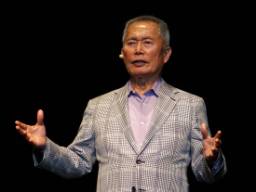
and activist George Takei (pronounced tah-Kay) filled the Arlington Theater to
capacity this week for his UCSB Arts and Lectures event. I grew up admiring him
as Enterprise pilot "Mr Sulu" on Star Trek. I knew he went on to be
an advocate for LGBTQ rights and I knew he had been interned as a child as an
American of Japanese ancestry. I also was one of millions of his followers on
Facebook. But I had no idea of his depth of thinking, activism and experience
until this event!
Here
http://swt.org/events/takei-2017-0215/
are all of my photos!
Loves Santa Barbara
Takei
began with his admiration for Santa Barbara. He and his husband Brad make this
their weekend getaway. They love the Spanish architecture and enjoy strolling
in Chase Palm Park. Brad was in the audience, incognito! Takei enjoyed meeting
with UCSB students earlier in the day.
Remembrance Day for Internment of Americans of Japanese Ancestry
But
then the talk got very serious. February 19 is Remembrance Day for Americans of
Japanese ancestry. That was the date when President Franklin Roosevelt signed
Executive Order 9066 which sent 120,000 Americans of Japanese ancestry to
concentration camps. Just because their faces resembled the faces of those who
bombed Pearl Harbor.
When
Pearl Harbor was bombed, thousands of Japanese-Americans had rushed to military
recruiting stations to volunteer to fight for their country: America. Their
offers were refused. They were declared "enemy aliens". A curfew was
imposed on all Japanese-Americans from 7PM to 6AM. Their bank accounts were
frozen. Then came the February 19 internment order.
Takei's Family Taken Away
February
20, 1942 was Takei's fifth birthday. He looked out the window of their home in
Los Angeles to see soldiers with bayonet rifles marching up to the door. With
no time for preparation, they were ordered to the Santa Anita Race Track. They
were to stay temporarily in the horse stables. To Takei's parents this was
degrading. The stables still smelled of horses and manure. But to young George
it was a fun adventure!
They
remained in the stables for a couple of months. Meanwhile, the government was
building ten internment camps around the country. The order applied to
Americans of Japanese ancestry who were along the West Coast. They were to be
moved far from the coast, allegedly for national security reasons.
They
were placed on trains with armed soldiers. Takei's family was taken to an
internment camp in Arkansas. At night a searchlight shone into the camp yard as
guards watched from towers. To young George he thought it was cool that they
were shining a light for him to find his way to the outhouse to pee at night!
Children
are adaptable. It was like a camp experience for young George. He got into the
routine. Mass meals that were not very good. Mass showers. Going to the
internment camp school. Where they recited the Pledge of Allegiance. "With
liberty and justice for all." Even as a child he noted the bizarre irony.
Injustice and Heroism
A
year after the internments began, the government realized there was a labor
shortage and wanted to recruit from the internees. But only if they
successfully passed a questionnaire. All internees age 17 and over had to
answer the questions which were full of contradictions and nonsense.
Question
27: "Are you willing to serve in the armed forces of the United States on
combat duty, wherever ordered?" This was asked of 80-year-old immigrant
women along with combat-aged American citizen men!
Question
28: "Will you swear unqualified allegiance to the United States of America
and faithfully defend the United States from any or all attack by foreign or
domestic forces, and forswear any form of allegiance or obedience to the
Japanese emperor, or any other foreign government, power, or
organization?" There was no way to answer both parts together!
Thousands
of Japanese-Americans did go to fight. The women were sent to the WACs. The men
were put in a segregated unit called the 442nd Infantry Regiment. They were
sent on the most dangerous missions in Europe and were the most decorated unit
for their size in US military history. They suffered a huge casualty rate.
President Truman later greeted them on the White House lawn and acknowledged
the prejudice against them.
But
some Japanese-Americans signed up for service as Americans. They were tried and
convicted for draft evasion! They were sent to Leavenworth Prison!
Released with No Compensation or Assistance
At
the end of WWII the internment camp gates opened. The people were given a one
way ticket to anywhere in the US. And $25. That was all. They had lost their
homes and everything they had owned. Many feared going back to the West Coast
where they had been before. Many went to Chicago, Cleveland, Boston or New
York.
But
Takei's family went back to Los Angeles. They were not welcomed back. Housing
and jobs were difficult to find for anyone after the war. For
Japanese-Americans the prejudice just made it worse. And they were only even
considered for certain stereotypical jobs like gardener.
Their
first home was on Skid Row. The drunks smelled of urine and were scarier than
the barbed-wire Arkansas internment camp. Instead of routine there was chaos.
Takei's
father had been a "block manager" in the camp. He was bilingual and
was seen as a leader. He opened an employment office in Little Tokyo. He was
able to place people in janitor and gardening jobs. But he only got a tiny
percentage. It was no way to survive and his mother insisted they look out for
themselves.
Mexican Americans Offer the First Welcome
So
they moved to East LA to the Mexican American Barrio. Finally, they had found a
place that welcomed them in! He made friends and enjoyed after school snacks of
frijoles (beans) on tortillas at their homes. He was embarrassed, though, when
his Mexican-American friends came to his house and his mother offered them
Wonder Bread with sugar on it!
Takei
fell in love with the Mexican-American culture. The food, the music, the
mariachi bands. He learned Spanish.
Takei's
parents worked their fingers to the bone. He could not believe that in just
five years they were able to buy a three bedroom house in the Wilshire
district!
Bigger Questions of Justice Lead to Action
Young
Takei was a voracious reader, learning history and civics. He loved the ideals
of the American founders who talked of life, liberty and the pursuit of
happiness. But how to reconcile this with the injustice he had seen?
Takei
was inspired by Martin Luther King. He challenged his father, asking why he did
not do more to protest for civil rights. His father said he had to think first
of them. The family. The kids.
Takei
saw this as the Peoples' Democracy. He appreciated the great ideas of the
founders. But they were also fallible human beings. Who kept other human beings
as slaves.
When
he pressed his father to get active, his father took him to the campaign
headquarters of Adlai Stevenson for president. The office was full of
passionate people inspired by Stevenson's leadership and visionary ideas.
Teenager George stuffed envelopes. He made phone calls. He leafleted. But the
brilliant Stevenson lost to the popular WWII General Eisenhower.
Takei
was determined to stay active in one campaign after another. Every one of his
candidates lost! Until he campaigned for Tom Bradley for Mayor of Los Angeles.
Bradley won in 1973 and served longer than any other mayor of LA. Bradley
appointed Takei to the Southern California Rapid Transit District Board.
Takei
was passionate about social justice. He was a singer in the 1960s social
justice musical "Fly Blackbird". He was thrilled when it played at
the Los Angeles Sports Arena. Even more thrilled when all of the singers were
invited afterwards to meet with Martin Luther King! He had a short chat with
King, who shook his hand. "I did not wash that hand for three days!"
Takei
joined the Entertainment Industry for Peace and Justice (EIPJ).
Long-Delayed Apology and Compensation
In
the 1970s Takei worked to get the US government to apologize for the
internment. They succeeded in creating a Congressional committee (CWRIC) where
Takei testified. It was a slow process. The CWRIC concluded that the internment
had never been based on actual national security. It was based instead on
"race prejudice, war hysteria, and a failure of political leadership"
in the words of the Congressional committee. The result was the Civil Liberties
Act of 1988 which apologized and paid each survivor $20,000. It also set up an
education fund to ensure this would never happen again.
The
amount was a token compared to what had been lost. But Takei saw it as a great
statement. It showed the US was big enough to admit a mistake.
"Allegiance" Film This Sunday for Remembrance Day!
"Allegiance"
is a Broadway musical based on the life of George Takei and he stars in it as
well. The musical was filmed and will be shown on Remembrance Day this Sunday February
19. Unfortunately, not in Santa Barbara. But he invited us to go to Ventura or
Oxnard to watch it!
He
noted that January 27 is Holocaust Remembrance Day. Both have the same message:
"Never Again!"
Never Again Poised to Happen Again – But Met with Resistance
How
ironic that Trump issued his Executive Order banning many Muslims from entering
the US on that same date, January 27. Trump used the same false claim of
"national security" used against the Americans of Japanese ancestry.
But this time was different. Thousands of Americans showed up to protest at
airports.
Acting
Attorney General Sally Yates refused to defend the order, asserting it was
un-Constitutional. Trump fired her. But Republican Federal Judge James Robart
blocked Trump's order on the same grounds.
Who
had Trump kept out by his order? Grandmothers. Students. A Syrian man who had
risked his life for the US as a translator. His daughter had been killed for
this.
Takei
characterized Trump as ignorant on a wide range of issues. He was certain that
the people will continue to resist his ignorant and unjust behavior.
Takei Realized He was Different
Takei
went on to a very different issue. Ever since he was ten years old he
discovered he was different from others. His friends would comment, "Sally's
cute" or, observing the developing breasts of another classmate,
"Monica's hot". He would think, "Yes, Monica is a nice person.
But Bobby, he's hot!" He thought he was the only one.
Teens
want to be popular, so Takei quickly learned to act as if Monica was hot. And
that was the start of his acting career! He was indeed popular and was elected
class president in junior high and high school.
He
was warned that if he was discovered to be gay it would end his acting career.
He discovered gay bars as a place to meet others like himself. But he was also
warned to be careful there. Police sometimes would raid gay bars. They would
photograph and fingerprint the patrons and put their names on a list.
He
thought it was terribly unfair that a person could lose their career just for
having a beer with friends. As unfair as he felt when he was discriminated
against for looking like the people who bombed Pearl Harbor. In both cases
people were being criminalized just for being who they are. He felt terrible
that this was the one issue he stayed silent about.
AIDS
was terrifying. He saw friends rapidly lose weight and die. He would contribute
money but stayed silent. Finally he walked in a major AIDS walk. Change was
starting.
Gay Liberation Movement Roots
Change
had already started in 1969 at the Stonewall Inn gay bar in Greenwich Village
in New York City. The police raided the place for no reason. But this time the
patrons decided to fight back. They threw things at the police. Whatever was on
hand. The police called for reinforcements. But so did the patrons! It became
more than a riot as the confrontation went on for days. After five nights the
police decided to offer to negotiate. That was the start of the Gay Liberation
Movement.
Marriage Equality
In
2003 the Massachusetts Supreme Court ruled in favor of marriage equality for
gays. In 2005 the first marriage equality bill in the US passed the California
legislature. But Governor Schwarzenegger vetoed the bill. He was playing to his
Republican base. Takei and others were enraged. This was what it took for Takei
finally to come out as gay and against Schwarzenegger's veto. He felt he
already had a good career and it was time to act.
In
2008 the California Supreme Court ruled for marriage equality. Takei and Brad
had been together 21 years at this point. They applied for and received the
first West Hollywood marriage license for a gay couple.
Takei
campaigned in DC. In the summer of 2015 the US Supreme Court ruled that
marriage equality is the law of the land. He and Brad were in the air, flying
from New York to Los Angeles when he heard the news. He was flying high in
every way as he looked out the window at the beauty of the Rockies.
We Are Making Progress
Takei
contrasted the shining ideals of the founders against the injustice of their
time. All men created equal. Women had no rights, not even over their own
children. Now we have women astronauts. A woman Federal Reserve Chair. And
three women Supreme Court Justices. Descendents of slaves are lawmakers now.
Nobility and fallibility both are woven into the American fabric.
"We
are making progress!" Takei triumphantly declared!
At
this point Roman Baratiak of UCSB Arts and Lectures offered questions to Takei
that had been collected via email in advance of the talk.
Remember and Improve not Forgive and Forget
Takei
was asked about forgiveness. His said that the key to dealing with adversity is
understanding. We should remember. Not forgive and forget. We should learn so
we never make that mistake again. We must improve government.
Creativity
Asked
about tapping into creativity, Takei said it is an individual matter. You have
to recognize your talents. The world will let you know if they are real. As an
actor, practice your craft even in small theaters. Spring back from rejections
and try again. But he is saddened to meet a 70-year-old bartender who says he
is "really" an actor. At some point you are really not an actor.
Minority Actors
Asian
Americans face special challenges in acting. Historically there were few roles
for non-whites. And those few roles were stereotyped as being a buffoon, a
servant or an evil character. Takei was determined to change this in his Star
Trek role. Luck is important. He sees the "Fresh off the Boat" TV
show as making progress.
African
Americans already overcame this challenge, one actor at a time. Starting with
Sidney Poitier. Now actors like Denzel Washington are "bankable".
Putting them in a film makes the film a success. That is the turning point.
Star Trek: Deeper Meaning, Diversity and Vision

Finally
Takei got to my passionate interest: Star Trek and its visionary creator Gene
Roddenberry. Takei made it clear that Roddenberry was a visionary who deserves
all of the credit for making Star Trek such a positive force. Roddenberry made
the cast deliberately diverse. He wanted the Starship Enterprise to be a
metaphor for Starship Earth. A team effort.
Star
Trek was revolutionary when it started in 1966. Other TV shows at that time
were sitcoms, cowboy shows and quiz shows. It was Takei's first break into a
television series, offering steady pay. It was a bonus for him to serve with a
diverse cast.
When
he arrived at Desilu Studios for work he expected the actors to be put right to
work learning their roles and scripts. Instead, they were taken to a conference
room with Roddenberry. Roddenberry explained his entire vision to them. He
wanted to use science fiction as a metaphor for all of the turbulence of the 1960s.
The Cold War. The US war in Vietnam. The social turmoil.
And
each cast member was to represent a continent. Captain Kirk represented North
America. Played by actor William Shatner who was a Canadian Jew. Europe was
represented by James Doohan. Everyone believed he really was the Scotsman
"Scottie" but in fact he, too was Canadian! "Jimmy" became
Takei's drinking buddy. He was of Irish ancestry but he drank enough Scotch to
be an honorary Scot.
Africa
was represented by Nichelle Nichols as communications officer Lieutenant Uhura.
In real life she was from Robbins, Illinois and was part Native American. Which
made her the most American of the cast. Takei represented Asia. (He was just
called "Sulu" taken from the Sulu Sea near the Philippines. It was
also a pun on producer Herb Solow.)
And
Leonard Nimoy of Boston represented those who were bi-racial as a bi-species
person. Nimoy became Takei's favorite political discussion cast mate.
Takei
was asked who was his favorite Star Trek captain. His character Sulu would have
to be loyal to Captain Kirk. But Takei favored Patrick Stewart as Captain
Picard. There had been a rumor of a revival of Star Trek. Takei was on a flight
from London to Los Angeles and he gathered a pile of newspapers for the flight.
He looked at his seat mate and he looked at the newspaper and realized his seat
mate must be the rumored new captain. Takei turned to Patrick Stewart and
started to ask, "Aren't you…" at the exact same moment Patrick
Stewart turned to him to ask the same question!
Takei
was not big into science fiction growing up. He did read Ray Bradbury and knew
him as a visible figure in Los Angeles. Roddenberry hired the best and
brightest science fiction writers of the era: Norman Spinrad, Theodore
Sturgeon, Harlan Ellison. Takei was turned on to read their writings as a
result.
Roddenberry's Visionary Extra Dimension
But
Takei made a point that I have tried to make for years: Current science fiction
may be full of action and adventure. But it is missing the Roddenberry
"extra dimension". That extra dimension of deeper meaning. A greater
positive vision. A meaningful social commentary. The Star Trek movies were
about saving the whales, about the Chernobyl disaster. Newer science fiction
films are not really about anything.
I
would argue that most current writers take the easy path of presenting
dystopian complaints about what is wrong. So much easier than offering a
utopian vision of how good things could be!
Positive Change Starts With a Positive Vision
Takei
affirmed this point as his key final point: Optimists get things done.
Optimists find where things can be improved and make those things better.
Pessimists lose from the start when they already "know" that change
is impossible. We are living in challenging times. But the optimists will
overcome. For three days after the election Takei was shell-shocked. Then it
was time to get to work. Once again he affirmed, "We are making
progress." Trump has already lost his Labor Secretary and his National
Security Advisor due to public outrage. Takei is confident that Trump will have
an "abbreviated" presidency. Confident that the people will fight and
the people will prevail!
And
it is not just about being optimistic. It is about that extra Roddenberry
dimension: Taking the time and effort to create a detailed vision of a truly
better future. To imagine going where no one has gone before!